Introduction
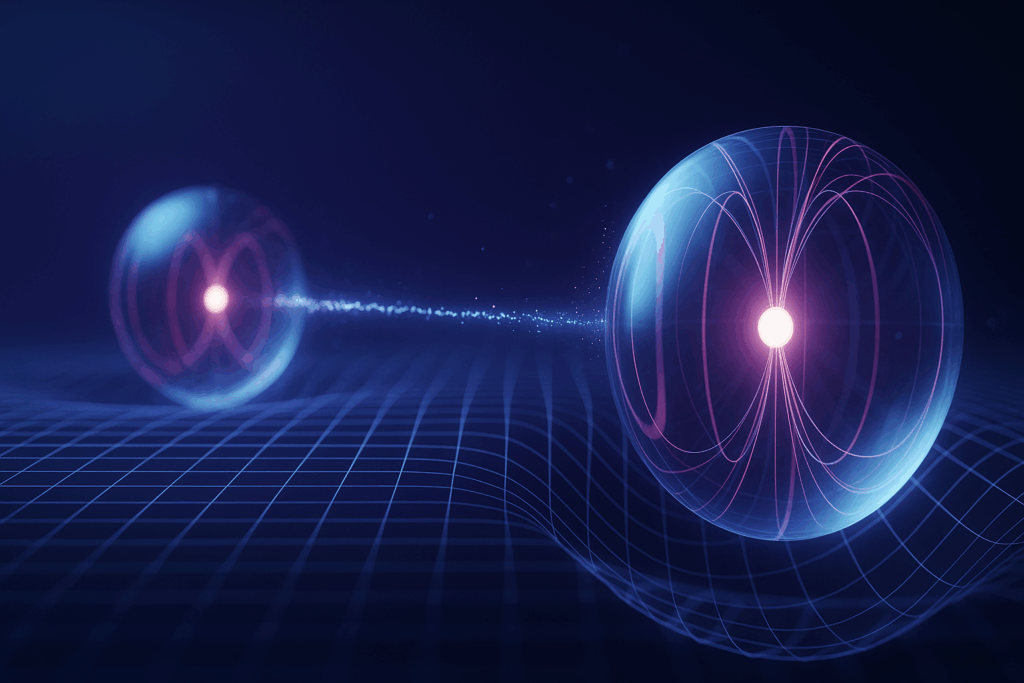
We use our smartphones daily, often unaware that their chips harness peculiar properties of the quantum world. The strange effects once thought confined to atoms are now a part of devices we barely notice.
In 2025, the Nobel Prize in Physics was awarded to John Clarke, Michel H. Devoret, and John M. Martinis “for the discovery of macroscopic quantum mechanical tunnelling and energy quantisation in an electric circuit.”
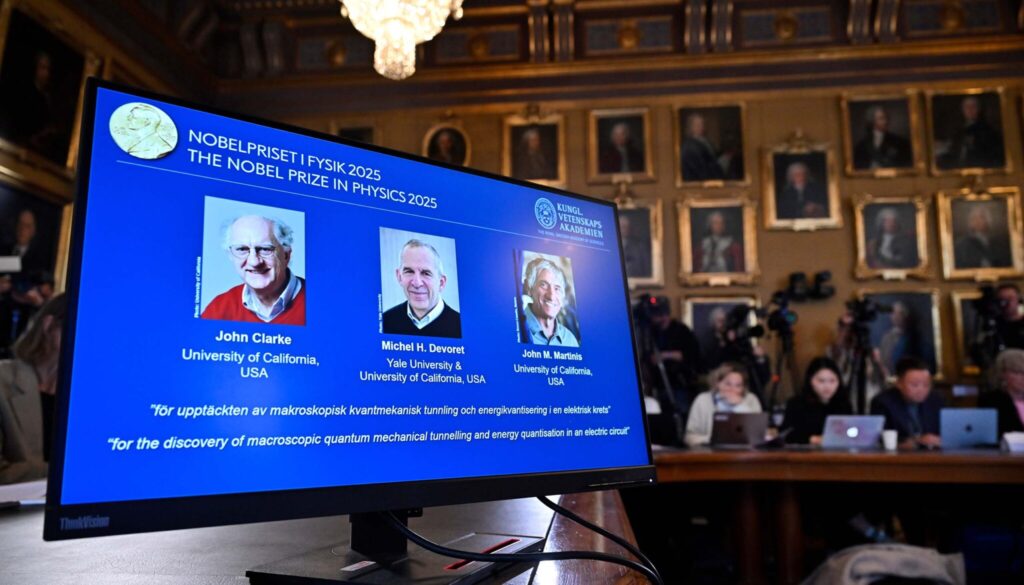
John Clarke, Michel H Devoret and John M. Martinis pictured on screen after they were awarded with this year’s Nobel Prize in Physics, at the Nobel Assembly of the Karolinska Institutet, in Stockholm, Sweden. Credits: Christine Olsson/TT News Agency via AP
At first glance, the statement may sound highly technical, but in essence, it represents a revolution in how humanity interacts with the quantum world. Through their experiments, scientists have been able to scale up the delicate rules of Quantum Mechanics, once confined to the invisible domain of electrons and atoms, into circuits that can be built, held, and even observed. This isn’t just another physics milestone; it is a turning point in our understanding of reality itself.
In this article, we will explore the concepts behind this science, what this truly means, how these experiments redefined the limits of the possible, and what their success reveals about our evolving relationship with nature and technology. Because when the quantum world goes big, it doesn’t just change physics, it changes us.
A Brief Primer: Quantum Tunnelling & Energy Quantization
To understand the magnitude of this year’s Nobel-winning discovery, let’s first pay a visit to the very core of quantum strangeness. This is a world where particles behave like waves, energy is not continuous but comes in discrete packets, and a particle can exist in multiple states or locations simultaneously until it is measured. As many of these behaviors are not experienced in our day-to-day lives, they seem “spooky” or bizarre, even troubling one of the brightest minds in science – Albert Einstein.
Quantum Tunnelling: When Barriers Don’t Mean “Stop”
In the classical world – the world of footballs, cars, and coffee cups, an object cannot cross a barrier higher than its own energy. But in the quantum world, particles are not bound by any such limitations. They can “tunnel” through barriers that should, by every law of Newton and common sense, be impassable.
Let’s try to understand this through a common real-life example. Think of throwing a basketball toward a wall. If the ball does not have enough energy to go over or break through the wall, it will just bounce back. This is how everything around us behaves; all follow classical physics – they need enough energy to overcome an obstacle.
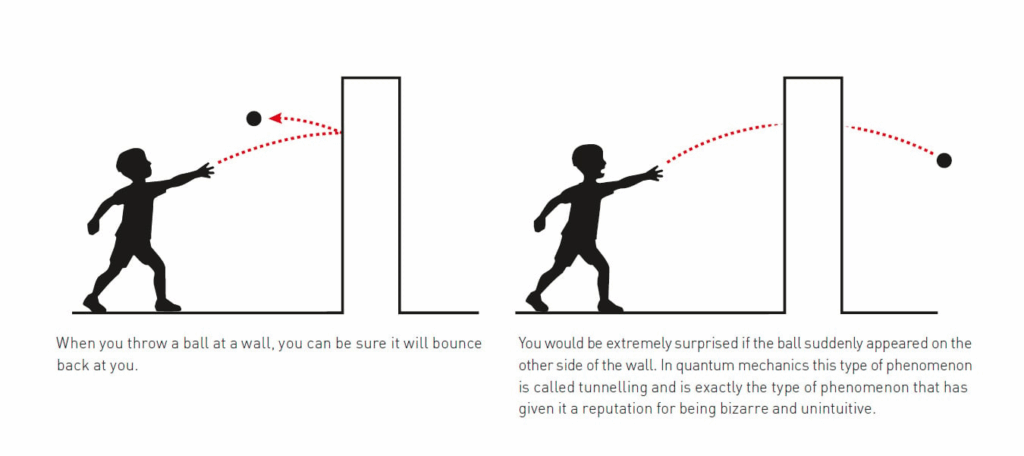
When we zoom down to the smallest scale – electrons, protons, atoms, things get weird. These particles are not like scaled-down balls. They behave more like waves – fuzzy clouds of probability.
In the quantum world, particles do not have precise positions or energies until we measure them. They exist in a blurred state of probabilities.
So, when such a quantum particle encounters a barrier that it shouldn’t be able to pass through, part of its wave can actually extend through the barrier. This gives a small but real chance of the particle appearing on the other side.
It is though as if the basketball sometimes mysteriously appears behind the wall, not by going over or breaking it, but by passing through it – just being there, because in the quantum world, probabilities dictate the norms, not certainties as in the classical world. It is not breaking any rule; it is only obeying quantum laws that are just different from Newton’s.
This “tunneling effect” has long been observed in the subatomic space – in the fusion reactions that power the Sun, in radioactive decays, and in the workings of semiconductors.
However, until recently, it was considered to be a purely microscopic phenomenon and something far too stretched to ever be seen in the electric circuits that we could touch or measure directly.
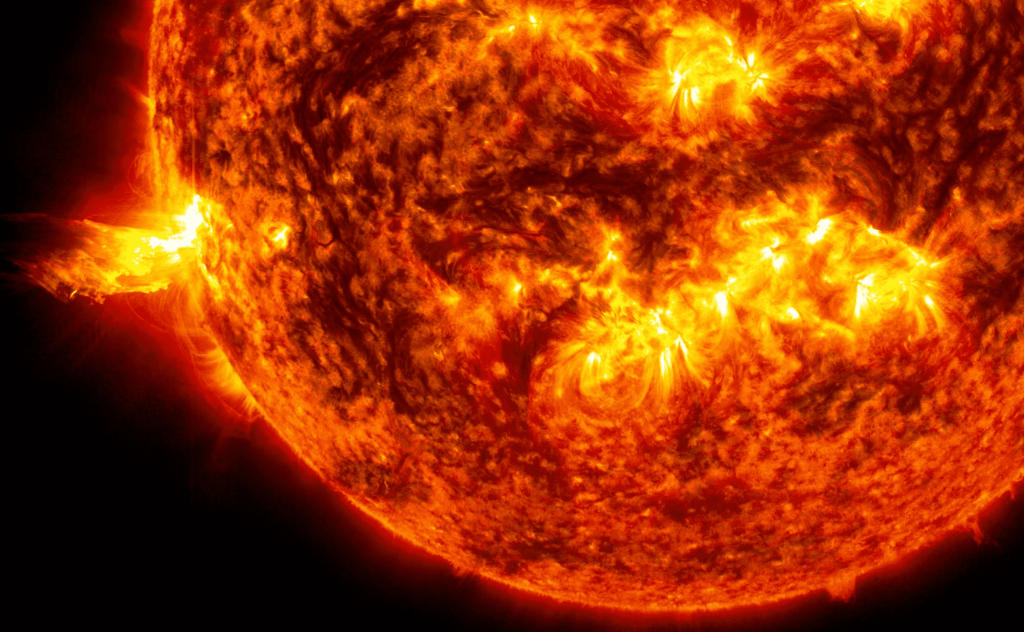
Nuclear fusion in the Sun occurs through the proton–proton chain reaction, in which hydrogen nuclei (protons) combine to form helium, releasing vast amounts of energy. Yet, the Sun’s core isn’t hot enough for protons to classically overcome their electrostatic repulsion—known as the Coulomb barrier. Quantum tunneling provides the key: it allows protons to “tunnel” through this barrier even without enough energy to cross it directly, enabling fusion to occur and powering the Sun.
Energy Quantization: Nature’s Discrete Notes
We are used to thinking of energy as something continuous. For example, we can heat water to any temperature – 98°C, 98.10°C, 99.25°C, and so on. The energy you give seems infinitely adjustable. In other words, energy feels like a smooth dial; we can turn it by any small amount we like.

But in the quantum world, this isn’t true. At the dawn of the 20th century, eminent physicists like Max Planck and Niels Bohr revealed that energy doesn’t take a continuous form – it comes in discrete packets called ‘quanta’. A real-life analogy can be thought of as the keys of a piano, which are discrete units, while the smooth slide of a violin is continuous.
Electrons around atoms stay put in well-defined energy levels. To jump from one level to another, it must absorb or emit a specific packet of energy – a photon.
This concept is known as “energy quantization”, which shattered the classical illusion of smoothness. It led to our understanding of atoms, lasers, semiconductors, and even blackbody radiation.
The Laureates and Their Breakthrough
John Clarke, an emeritus professor of physics at the University of California, Berkeley, led one of several groups in the 1980s that aimed at demonstrating macroscopic quantum tunneling (MQT) in superconducting circuits. Working with Martinis, then a graduate student, and postdoctoral fellow Michel Devoret from the Centre d’Etudes Nucleaires de Saclay, France, Clarke devised an experiment for confirming the existence of MQT undeniably.
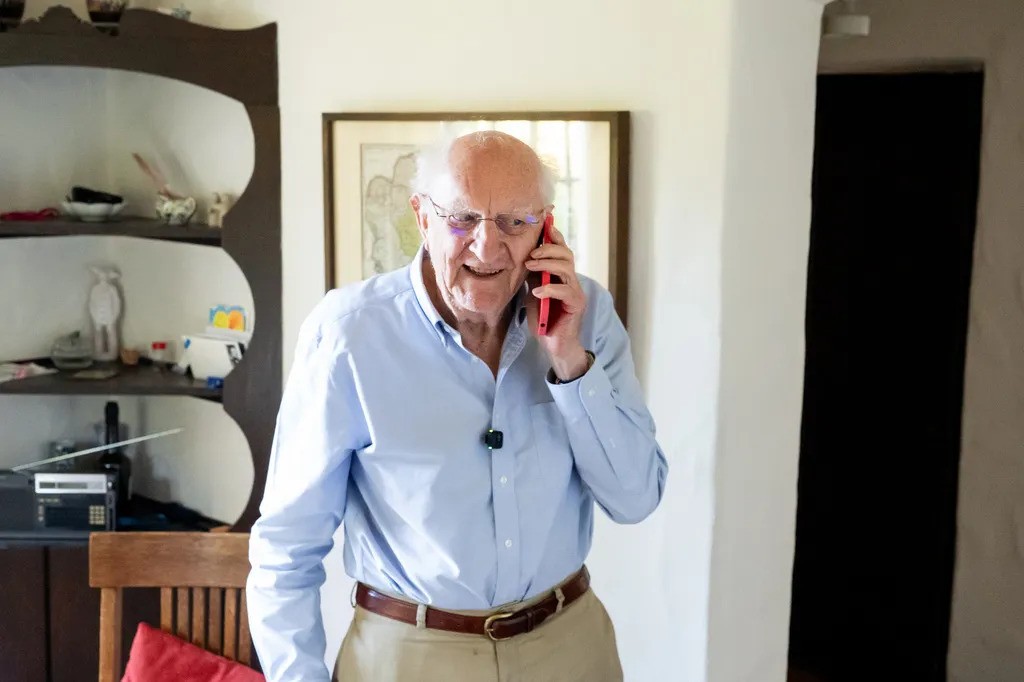
Clarke said he was stunned and overwhelmed to hear the news. His daughter called early in the morning to congratulate him on the win, and he said he had hundreds of emails in his inbox. “To put it mildly, it was the surprise of my life,” Clarke told reporters at the announcement by phone after being told of his win.
At Yale and later UC Santa Barbara, Michel Devoret carried Clarke’s vision forward. Currently a professor emeritus and a research professor in the Yale School of Engineering & Applied Science’s applied physics department, Devoret would go on to conduct some of the seminal design work on quantum superconducting circuits. He is also chief scientist for Google at Quantum AI in Santa Barbara.
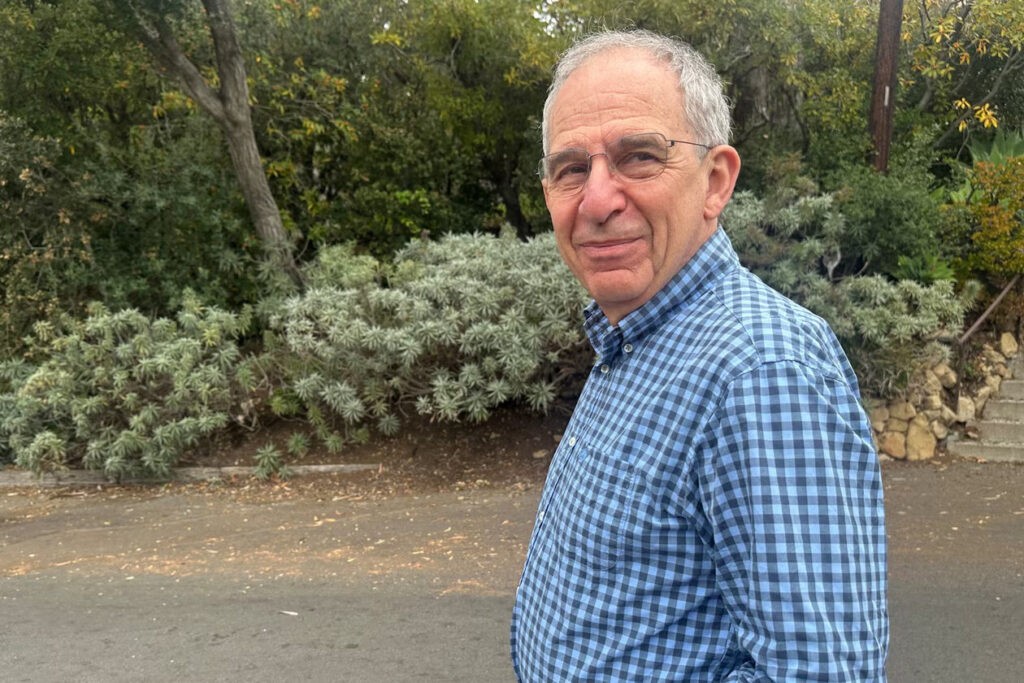
“My son told me something I had not fully processed, that the Nobel is more than a science prize. It makes you switch into a parallel universe tied to the popular culture.” When asked how that makes him feel, Devoret laughed. “I feel like someone who has just won a Nobel Prize,” he said.
At the University of California, Santa Barbara, and later at Google’s Quantum AI Lab, John Martinis turned this foundational science into working technology. If Clarke was the architect and Devoret the craftsman, Martinis was the builder who brought it all together. His experiments showed that superconducting circuits made with Josephson junctions could exhibit quantum energy levels and tunneling.
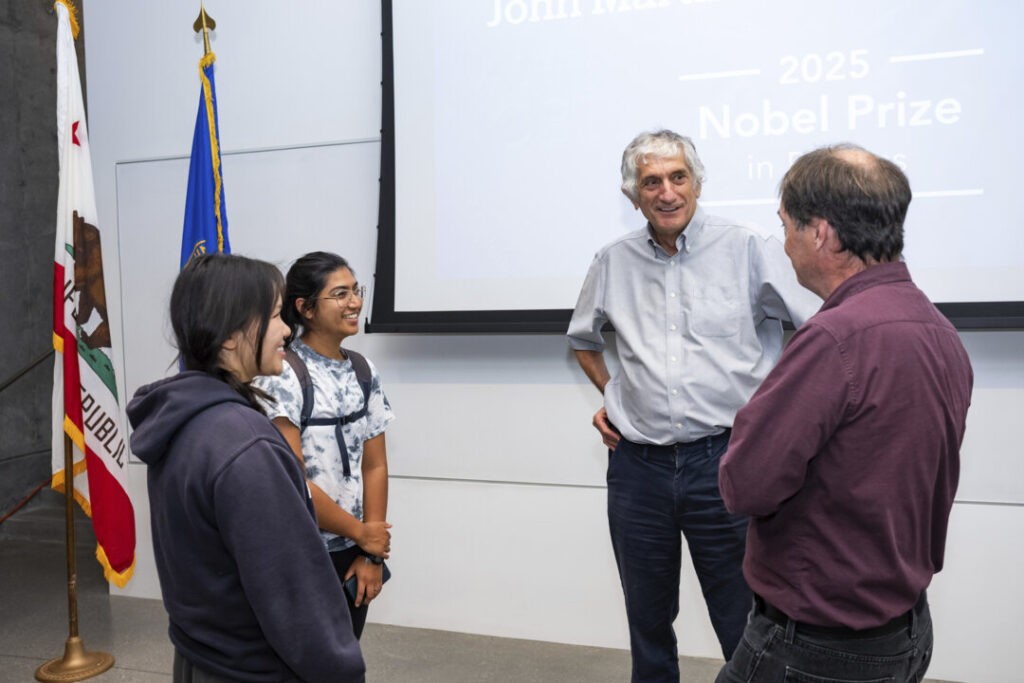
Photo: Jeff Liang, UC Santa Barbara.
“It is a great honor to be awarded the Nobel prize,” Martinis said. “I am grateful to have worked with John Clarke and Michel Devoret during my PhD thesis, as they taught me how to do compelling experiments. The global physics community has also contributed greatly to the success of superconducting qubits. Next, let’s build a useful quantum computer!”
During their experiments in the 1980s, the scientists could show macroscopic quantum mechanical tunneling and energy quantization in an electric circuit, a superconducting device large enough to be held in one’s hand.
At the heart of their experiments was a Josephson junction – a device formed by two superconductors separated by an ultra-thin insulating barrier. (A Josephson junction is a crucial component in superconducting circuits, allowing for quantum effects to be observed at larger scales). In superconductors, electrons pair up (called Cooper pairs) and move without resistance. In these experiments, the circuit was cooled to very low temperatures (near absolute zero) so that the system behaved in a coherent quantum state. The entire system was thus treated as one macroscopic quantum variable rather than countless individual electrons.



This macroscopic particle-like system is initially in a state in which current flows without any voltage. The system is unable to change this state and is trapped, as if behind a barrier that it cannot cross. The experiment was able to show the system’s quantum character by managing to escape the zero-voltage state through tunnelling. The system’s changed state is detected through the appearance of a voltage.
In other words, the circuit (effectively one giant wavefunction) would suddenly generate a measurable voltage, a direct sign of the quantum state having “jumped” the barrier. This was macroscopic quantum tunnelling (MQT).
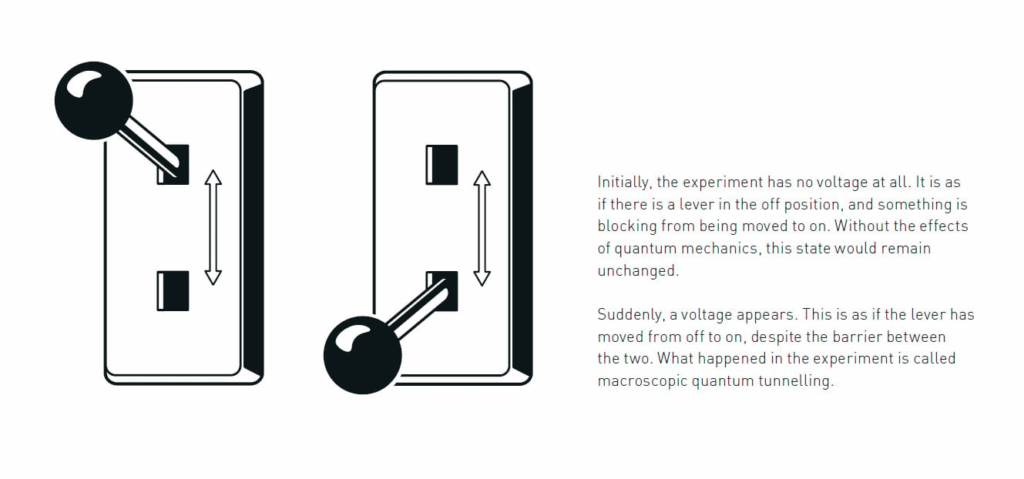
The researchers did not stop at tunnelling. The team also demonstrated that the circuit absorbed and emitted energy in discrete values – quantized energy states. This is much like an atom’s electrons jumping between defined orbitals as discussed earlier. In this circuit context, microwaves were used to excite the system, and the response showed clear steps in energy rather than a smooth continuum.
Thus, this system acted like an artificial atom: a circuit that had discrete energy levels and could tunnel like a particle.
Very well-known in atoms, individual particles, and miniature systems, quantum effects disappear when we aggregate many particles. This phenomenon is known as ‘decoherence’ (Decoherence describes how quantum states lose their quantum behavior and become classical when interacting with their environment or large numbers of particles).
What Clarke, Devoret, and Martinis demonstrated was that such effects could persist in systems made of billions or trillions of electrons and macroscopic components – in devices you could hold. This broke the boundary between “micro” and “macro” in quantum physics.
In essence, they turned the abstract mathematics of quantum mechanics into a day-to-day measurable phenomenon. The silent poetry of the microscopic world now resonated through circuits – tangible and testable.
From Lab Marvel to Real-World Impact
In the quiet laboratories of Berkeley and Yale, what once seemed like a philosophical curiosity began to take on hardware form. The circuits devised by Clarke, Devoret, and Martinis were not just proof-of-concept physics experiments; they were the prototypes of a new kind of machine.
Those Josephson junctions led to the foundation of the superconducting qubit. These qubits behave like artificial atoms: they can exist in multiple states at once (superposition) and interact through entanglement. Every Google or IBM quantum processor today carries the conceptual DNA of these 1980s breakthroughs.
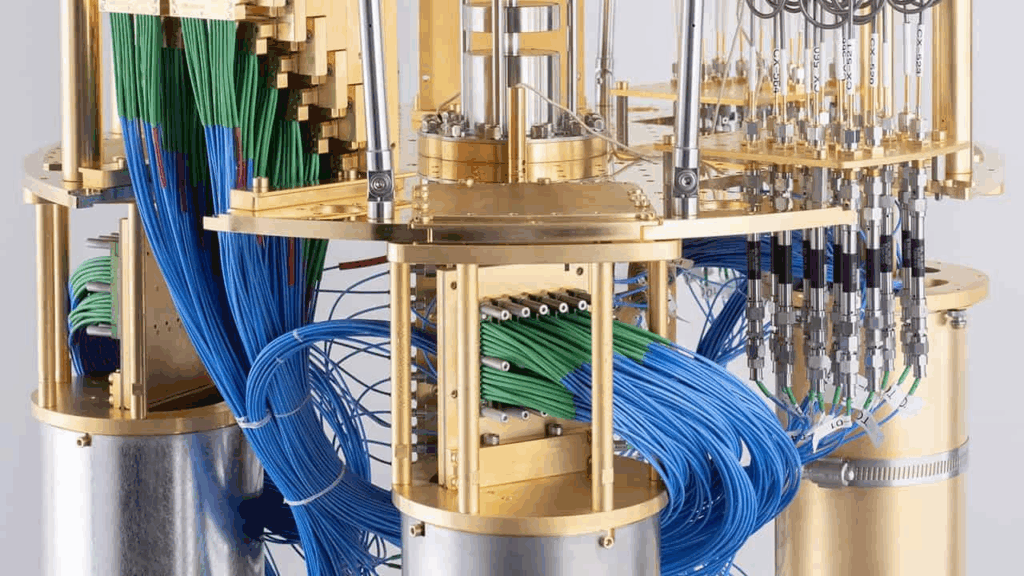
The Josephson effect, discovered in 1962 by Brian Josephson when he was only 22, was initially considered a theoretical curiosity with no practical use. Decades later, that same principle became the foundation for superconducting qubits, which now power the quantum processors leading the race in quantum computing.
But the ripples extend far beyond computation. Quantum tunnelling underpins ultrasensitive detectors called SQUIDs (Superconducting Quantum Interference Devices). They are used in numerous applications, including the detection of NMR (Nuclear Magnetic Resonance) signals at ultralow frequencies, geophysics, the nondestructive evaluation of materials, and as biosensors.
To understand why this is revolutionary, imagine the boundaries between science fiction and engineering dissolving in real time. Before these experiments, quantum mechanics belonged to the domain of abstraction – equations and probabilities locked within the atom. What the laureates did was drag it, gently but decisively, into the macroscopic world.
The Schrödinger’s cat of our technological imagination has finally stepped out of the box – not dead, not alive, but computing.
What This Tells Us About the Nature of Reality
For more than three centuries, humankind thrived in the comforting embrace of Newtonian order – the world followed rules, measurable and predictable, every motion had a cause, every effect could be traced back to its root. Then came Quantum Mechanics and brought with it something profoundly unsettling – the universe is not comprised of certainties but of probabilities.
The quantum effects are no longer confined to the atomic world and have begun to appear in circuits that we can build and hold. The boundary between the classical and the quantum is no longer a wall or an impenetrable barrier – it is a gradient, perhaps even an illusion.
We interpret the world in ways that make it navigable, but not necessarily accurate. The laureates’ experiments, in making quantum phenomena visible at human scales, have also made this philosophical rift tangible: reality is stranger than we are built to perceive.
And here, a parallel quietly emerges and should be talked about. It is related to another technological frontier of our time – the blur between humans and machines. Just as Large Language Models (LLMs) mimic our thought and conversational style until we struggle to point out the difference, quantum systems mimic classical behavior until we attend closely enough to see the wave behind the particle, the probability behind the certainty.
Both frontiers, artificial intelligence and quantum physics, confront us with the same perturbing question: What does it mean to be real?
Every time we hold a smartphone, run a quantum processor, or even send a message online, we engage with layers of abstraction that conceal immense complexity. Inside that silicon chip, electrons don’t merely flow – they tunnel, superpose, and entangle, turning the strangeness of the microscopic world into the functionality of our macroscopic lives.
The Road Ahead
The fable of quantum technology has only begun. For all the progress these laureates ignited, the challenges are quite formidable – decoherence, where fragile quantum states collapse under the slightest environmental disturbance; error correction, which demands protecting quantum information from errors by encoding it across multiple physical qubits to form a single, more robust “logical qubit”; and scalability, the art of arranging multiple quantum components to work in harmony.
Michel Devoret himself, in a characteristically humble reflection, cautioned against triumphalism. He described the field as “still learning to make quantum mechanics work for us,” acknowledging that the road to practical quantum systems will require as much patience as it does ingenuity.
Yet beneath the science lies something deeply human – the quiet persistence of curiosity. Clarke mentored Martinis, who in turn mentored a new wave of experimentalists carrying the field forward.

Now, as quantum technology moves from the lab to the marketplace, society faces its own moment of introspection. What will we do with this power? Will we use it to accelerate discovery and understanding, and decode the mysteries of nature, or will it become yet another race of advantage, where the profound becomes commodified?
Photo by Jonathan Meyer on Unsplash
Perhaps the real promise of quantum computing is not computational speed, but conceptual expansion. When machines begin to operate under the principles of quantum reality – embracing uncertainty, superposition, and entanglement, they may not just compute differently – they may compel us to think differently. They might force us to ask deeper questions: not only about how the universe works, but about how we fit within it.
And in that sense, this Nobel Prize is not a conclusion; it is an invitation. To build, to wonder, and to remember that behind every quantum leap stands the quiet persistence of human thought.
References:
- Press release. NobelPrize.org. Nobel Prize Outreach 2025.
https://www.nobelprize.org/prizes/physics/2025/press-release/ - Groundbreaking quantum-tunnelling experiments win physics Nobel
https://doi.org/10.1038/d41586-025-03194-2 - Nobel Prize in physics awarded to 3 University of California faculty
https://www.universityofcalifornia.edu/news/nobel-prize-physics-awarded-3-university-california-faculty - Superconducting quantum bits
https://doi.org/10.1038/nature07128 - Energy-Level Quantization in the Zero-Voltage State of a Current-Biased Josephson Junction
https://doi.org/10.1103/PhysRevLett.55.1543
This article is authored by Abhinav Singh.

Subscribe to Primitive Proton Newsletter
Sign up to keep up to date with the latest news and curated blogs in the world of space, science, and technology.
Your email is never shared with anyone. You can opt out anytime with a simple click!
WE PRIORITISE PRIVACY.