
Prologue: A Planet in Passing
In one of the cold evenings of December 1968, as the Apollo 8 mission was underway, a photograph was taken from lunar orbit by astronaut William Anders. The image would come to be known as ‘Earthrise’. It showed a distant, radiant Earth lifting itself above the barren horizon of the Moon: a seamless, borderless world. It was just a fragile sphere suspended in the vastness of space.
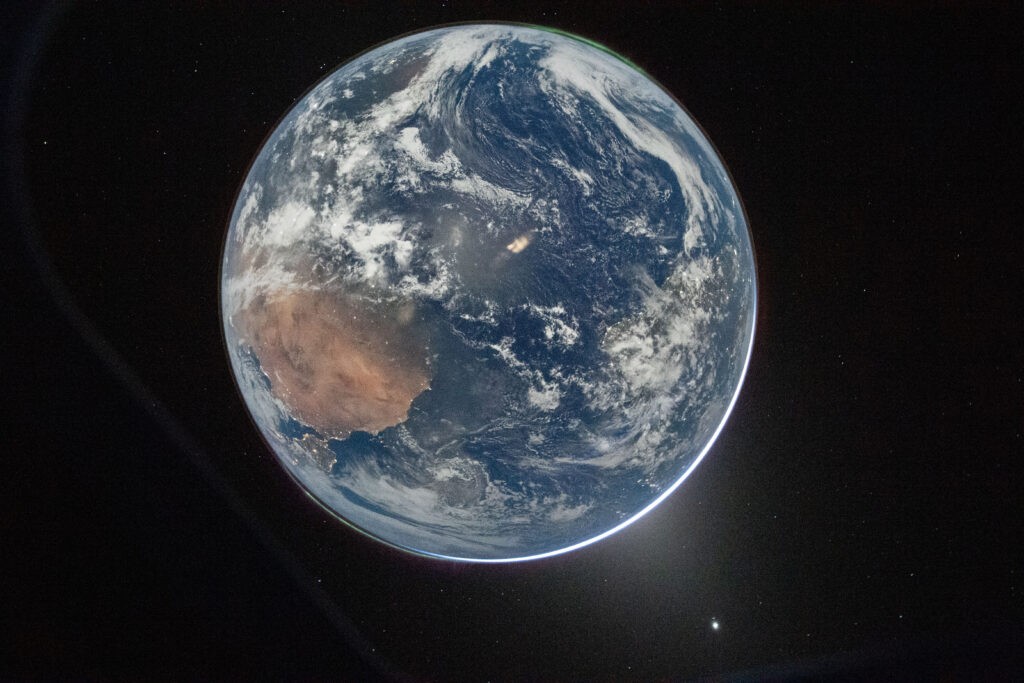
Nearly six decades later, during the recent Artemis II mission, another image was captured. This time, Earth was not rising; it was receding. The photograph, now called ‘Earthset’, showed our planet slipping behind the Moon’s ragged terrain. Earth faded into darkness as the spacecraft drifted onward.
Neither of these images is a mere photograph. They are mirrors, held up at different moments in time, reflecting not only what Earth is but also what we, as a species, have chosen to become in relation to it.
1968: When Humanity saw Earth
The Apollo 8 mission was never meant to be an act of introspection, or, better said, a philosophical turning point. It was, including all the Apollo missions, a bold geopolitical and technological undertaking, a showcase of capability and superiority in the prevalent Cold War. And yet, somewhere between those mission-critical manoeuvres and complex orbital mechanics, that photograph of ‘Earthrise’ quietly transcended its intent.
Astronauts William Anders, Frank Borman, and James Lovell Jr. travelled around 930,000 kms aboard the Apollo 8 spacecraft and made history as the first humans to orbit the Moon. They viewed Earth in a way that no simulation or imagination had prepared humanity for. It happened a few minutes after 10:30 AM Houston time on 24th December, 1968, as Apollo 8 was coming around from the far side of the Moon.
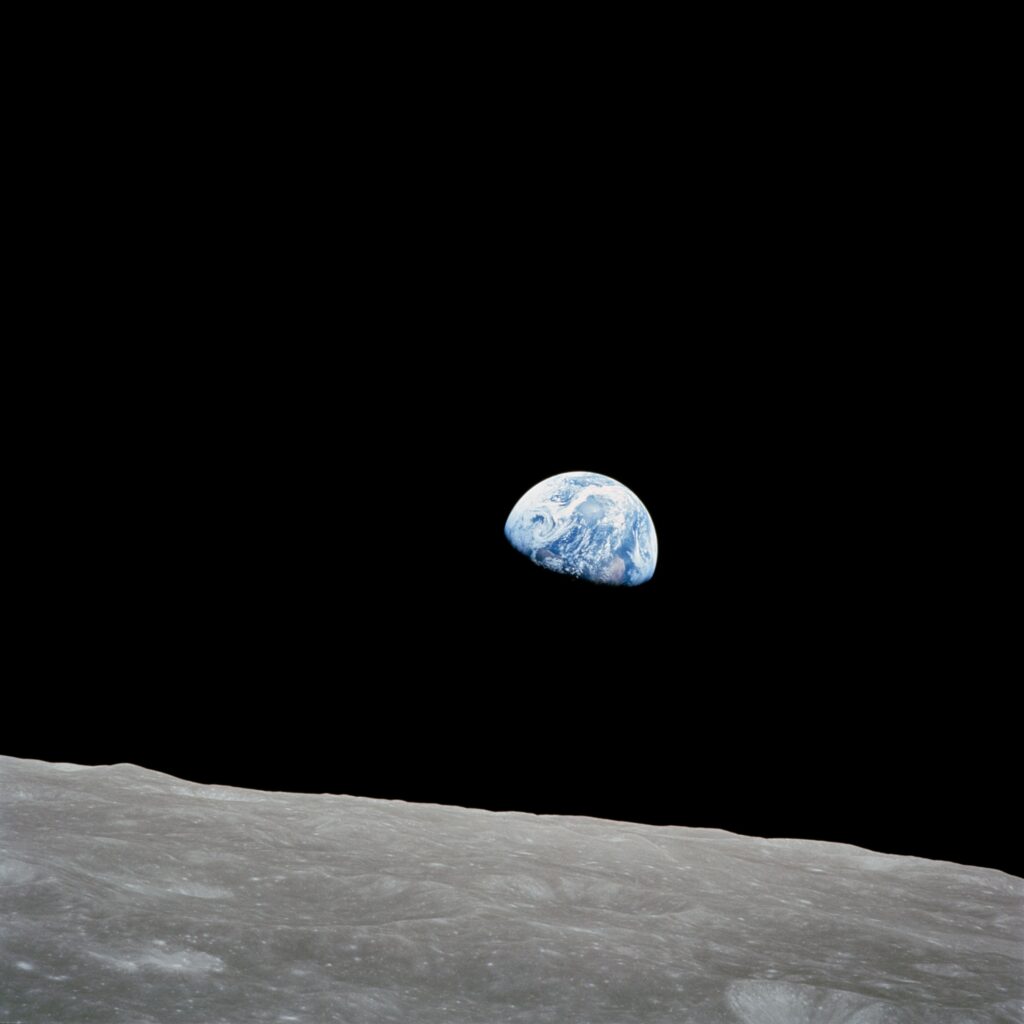
–William Anders, Apollo 8, December 24, 1968. Credit: NASA
For the first time in history, Earth was no longer the ground beneath our feet, to which we are all gravitationally bound. It was an object – finite, isolated, and surprisingly delicate. The shift in perspective was around the corner – every border, every war, and every ambition compressed into a tiny blue sphere. The overwhelming scale of human conflict suddenly felt disproportionate.
Earthrise in Culture, Politics, and Philosophy
The ‘Earthrise’ image did not remain confined to scientific archives. It journeyed into classrooms, onto posters, across newspapers and magazine covers, and into the collective imagination across nations. By influencing writers, thinkers, artists, and social activists in their own ways, it steadily began to reinterpret Earth not as a stage for human drama, but as a frail protagonist in its own right.
The Apollo 8 mission and Earthrise as included in the May 1969 edition of the National Geographic Magazine.
In the backdrop of the Cold War, where global identity was being drawn by ideological divisions, primarily between capitalism and communism, ‘Earthrise’ introduced a much-needed counter-narrative. From the Moon, none of the borders were visible; Earth was rather a single luminous entity suspended in silence. It was perhaps the first truly global image, one that subtly challenged the concept of division itself.
Politically, this began a slow but significant transition. Legislation related to the environment and ecology started gaining traction. International cooperation and talks around climate and conservation began to take shape. The idea that Earth was a closed system, with a fine balance of resources and consumption, and shared consequences, started to influence and guide policy frameworks that were not limited to a single nation on the planet.
Just a few months after the photograph, on 22nd April, 1970, the inaugural Earth Day was celebrated. The image acted as a catalyst. ‘Earthrise’ became a beacon of hope. Millions of people participated actively in demonstrations, protesting, and spreading awareness about environmental deterioration and ecological damage.
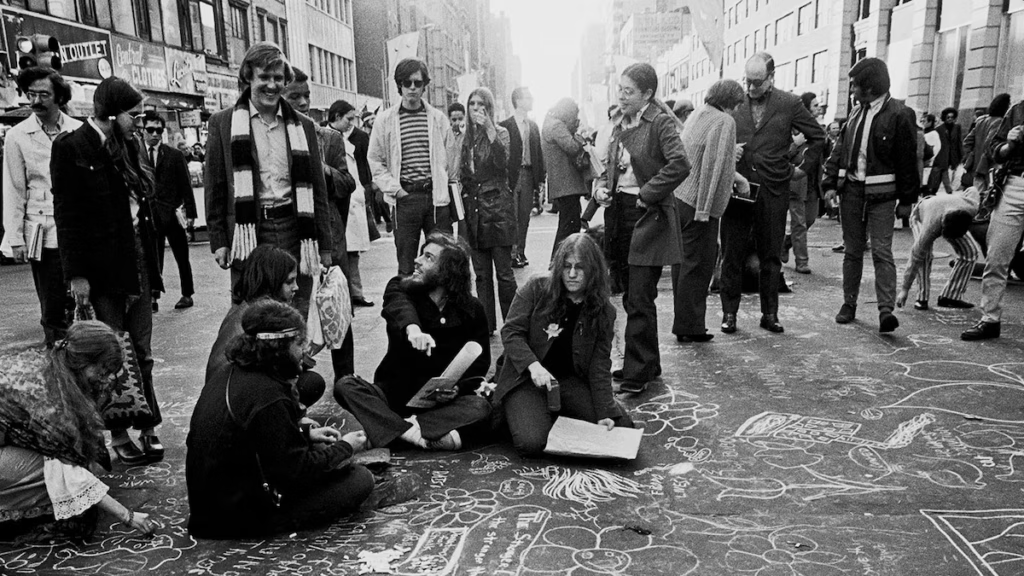
Towards the end of the year, the U.S. Environmental Protection Agency was established, and some trailblazing laws such as the Clean Water Act, Clean Air Act, and the Resource Conservation and Recovery Act were implemented.

2026: Earthset and the Return of Perspective
The Artemis II mission has been framed as a return to the Moon, thereby becoming the foundation of future Moon landings and paving the way for human exploration of Mars. It marked the first human lunar flyby since 1972.
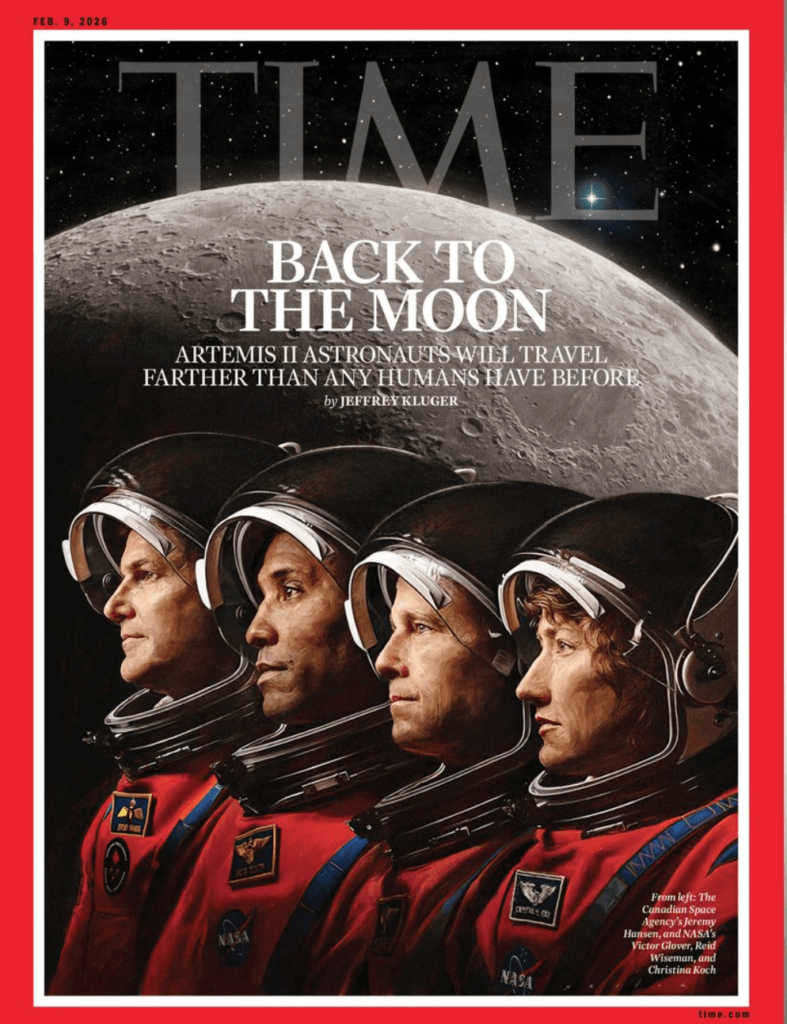
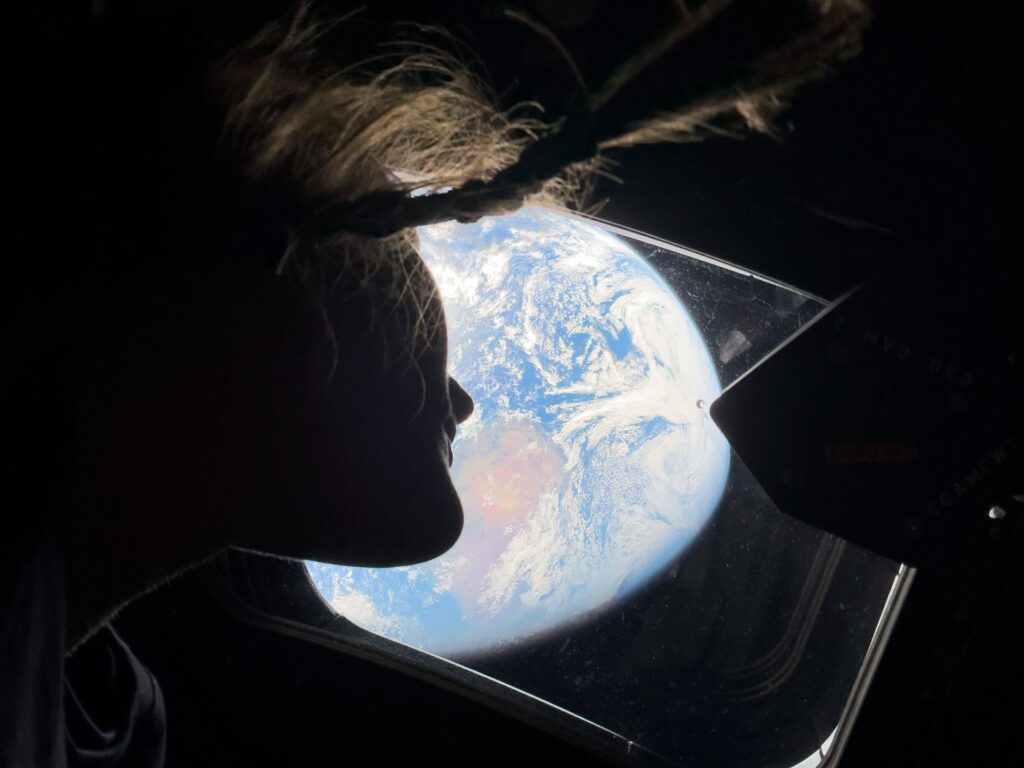
It was during the spacecraft’s passage along the far side of the Moon that the photograph now known as ‘Earthset’ was captured. As the crew was photographing Moon’s terrain, including craters and ridges, they saw Earth, partially illuminated, descending behind the Moon’s rugged horizon, gradually slipping out of view. The light faded, the connection weakened, and for a brief amount of time, humanity’s only home was no longer visible. It might have brought in a slight discomfort on realising how easily it can be lost from sight.
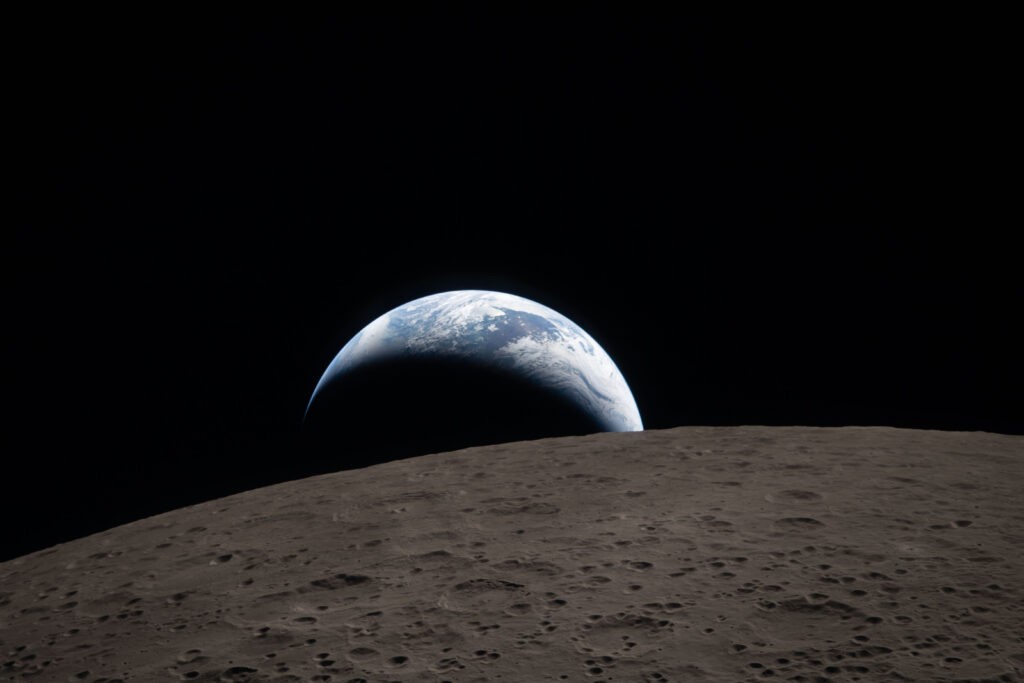
If Earthrise evoked unity, Earthset reveals finiteness. As humanity aims to extend its presence beyond its home planet, there is an accompanying risk – that distance may dilute intimacy, that expansion may weaken attachment.
The image arrives at a time when space is no longer the territory of symbolic exploration alone. In the last few years, it has become operational and commercialised. This image, in a way, reminds us that no matter how far we go, the question of belonging will always linger in our hearts. In watching Earth disappear, we are confronted not with loss, certainly not now, but with a possibility – the possibility that we may one day learn to look away, and there is something quite unsettling in this realization. And that, perhaps, is the most profound perspective shift of all.
From Rising to Setting: Sustainability, Morality, and Inclusiveness
Between Earthrise and Earthset, it is not only that time has elapsed, but the duration can also be thought of as a metaphor for the arc of human consciousness.
Earthrise was a beginning, arriving like a revelation, telling us that we are one on this spacecraft called Earth, traveling in space, that our borders and divisions were superficial, that our home was both fragile and shared. It was, in many ways, a moment of collective humility.
“We came all this way to explore the Moon, and the most important thing is that we discovered the Earth.”
– William Anders
Earthset, by contrast, feels like a reckoning. It does not reveal anything new, but reflects something unresolved. The same planet, the same fragility, the same commonship, but now seen in retreat.
In the crowd of modern business and lifestyle, sustainability is often reduced to metrics such as carbon emissions, energy consumption, carbon targets, emission curves, etc. Earthset reframes sustainability not as a technical challenge, but as a perceptual one.

For most of human history, our planet has been vast enough to absorb whatever we did. Forests seemed endless, oceans boundless, and the sky immeasurable. But human action has had an exponential jump in recent years, and all that everlastingness now seems to be an illusion.
Today, humans and their actions are no longer within nature; they are actively reshaping it. Climate change, biodiversity loss, ocean acidification – these are not isolated problems; they are signals that the strain on our planet is unbearable now, whose capacity is finite and responsive.

Sustainability is now less about managing resources and more about maintaining a relationship with our only home.
While Earthrise subtly expanded our moral imagination – from individualistic to collective, Earthset pushes it further. It emphasises that morality can not remain human-centred if the conditions for human existence themselves are at a grave risk. Ethics must evolve to include not just people, but also the ecosystem that sustains them.
From space, the notion of “otherness” dissolves, and “oneness” emerges. Earthrise made this visible, Earthset makes it poignant. In a world still defined by conflicts, wars, and fragmentation, the image of a receding Earth challenges many hard-held beliefs. If survival is shared, then exclusion becomes not just unjust, but irrational.
Thus, in so many ways, the transition from rising to setting is not a loss of hope, but a deepening of responsibility.
Cultural Possibility of Earthset
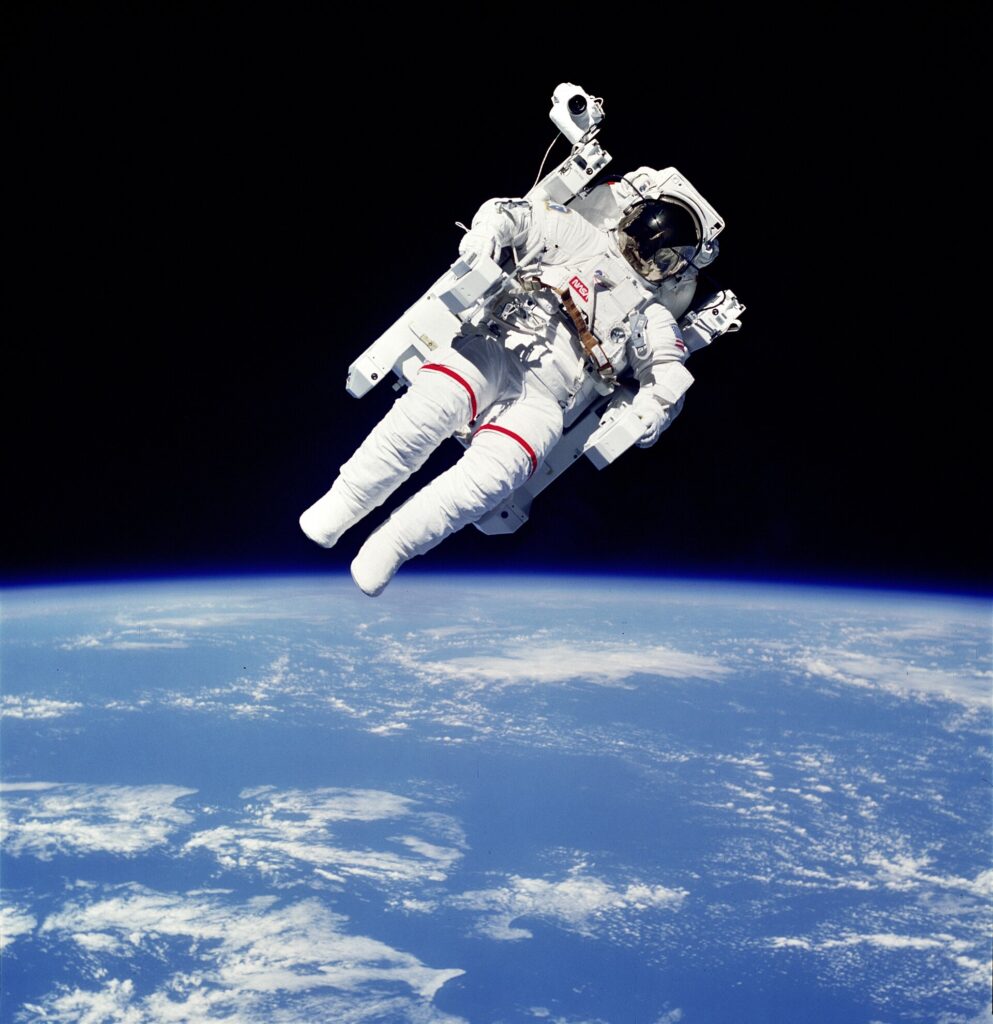
Earthset certainly feels like a continuation of a story left incomplete. We may begin to see a new wave of storytelling, one that is less concerned with leaving Earth and more with deserving it. Now, it should not be treated as any resistance to space exploration, because that is also a necessity. The idea, here, is shaping the climate narratives from distant catastrophe to intimate responsibility.
Incidents of melting ice caps in the Arctic, sea-level rise a few decades away, and temperature rising by 1.5-2°C are all scientifically valid, but also psychologically remote. They operate at a scale where individual contribution feels negligible. The result is a paradox: the problem feels enormous, yet our role within it feels insignificant.
We will need to transition from being a spectator to being a participant. Under distant catastrophe, we are observers of a crisis. Under intimate responsibility, we become participants in a system.

Instead of asking, “Does my individual action matter?”, we need to ask, “What patterns am I part of reinforcing?”.
Instead of a perspective such as “The planet is in danger”, the shift should be towards “Does my way of living participate in that danger or its solution?”
Science fiction may evolve from an expansionist dream to ethical introspection – not where we can go, but what we must preserve before we do so.
In literature, cinema, and arts, Earthset could give rise to more existential themes, stories where distance from Earth is not an achievement, but a continued attachment, and where the absence of our home continues to be the central emotional axis.
Epilogue: The Last Glimpse of Blue
In Earthset, the gradual fading of colour, of light, of presence, has been duly captured. The planet is receding, not in reality, but in relation to the observer. And yet, the emotional truth it carries remains and feels absolute.
Everything we have ever known, every memory, every conflict, every act of love and kindness – has unfolded on this small glowing sphere, reflecting light from a distant star.
Earthrise once taught us that we share a home; Earthset doesn’t shy away from asking, “What does it mean to remain worthy of it?”.
There will, undoubtedly, be more missions, more images, and perhaps more distant horizons. But in all possibilities, nothing will be more consequential than this simple, recurring choice: To remember Earth and to act, not in the moments of crisis alone, but in the quiet continuity of care that sustains the world.
Because, one day, and perhaps sooner, we may find ourselves looking and travelling outward, searching the vastness of the Universe for meaning, only to realise that it was always contained in that last, fading glimpse of blue.
References:
- Artemis II
https://www.nasa.gov/mission/artemis-ii/ - Earthrise: A Conversation with Apollo 8 Astronaut Bill Anders
https://plus.nasa.gov/video/earthrise-a-conversation-with-apollo-8-astronaut-bill-anders/ - State of the Global Climate 2025
https://wmo.int/publication-series/state-of-global-climate/state-of-global-climate-2025 - Remembering Bill Anders
https://science.nasa.gov/missions/landsat/remembering-bill-anders/
This article is authored by Abhinav Singh.

Subscribe to Primitive Proton Newsletter
Sign up to keep up to date with the latest news and curated blogs in the world of space, science, and technology.
Your email is never shared with anyone. You can opt out anytime with a simple click!
WE PRIORITISE PRIVACY.